
Why Attic Ventilation Matters for Energy Efficiency
By REINSULATE LLC Editorial Team · Updated 2026-07-23
Attic ventilation keeps hot, moist air moving out through soffits and ridge vents instead of trapping it against the insulation. Combined with fresh attic insulation, that airflow stops R-30 attics from quietly drifting below R-10, so the AC stops overworking and energy bills stay lower year-round. This is the whole point of attic ventilation and energy efficiency working together: neither one does much good without the other.
Key Takeaways
- Balanced attic ventilation uses soffit intake and ridge exhaust to purge excess summer heat efficiently.
- Proper ventilation reduces ice damming risk in winter by maintaining consistently cold attic temperatures.
- Natural airflow removes moisture buildup in winter, protecting attic structural integrity and insulation performance.
- Strategic ventilation combined with insulation creates energy-efficient homes while lowering HVAC system operating costs.
Why does attic ventilation affect energy bills?
Stale, overheated attic air forces the AC to run longer and harder, and that shows up straight on the power bill. Poor attic ventilation compounds a problem that’s already common across Manatee County: insulation that’s broken down and stopped doing its job. Once those two issues stack up, high energy bills become the new normal instead of the exception.
Here’s what typically happens in older Florida homes. R-30 is a starting point, not a permanent guarantee. Heat and humidity compress and break down the material year after year, and that same attic can drop to half its original R-value within a decade or two, matching what we typically measure in older Manatee County attics we inspect. The U.S. Department of Energy recommends R-30 to R-49 for our climate. Plenty of local attics run at roughly half that protection. Add weak roof ventilation on top, and the attic turns into a heat trap with nowhere for that hot air to go.
How does poor airflow lead to higher AC bills?
Trapped heat sits directly above the living space, so upstairs rooms stay warm no matter how low the thermostat goes. The AC compensates by running for hours at a stretch, which drives up the bill every single month.
What airflow tips actually make a difference?
Balanced airflow matters more than any single vent or fan. A few practical airflow tips:
- Pair fresh insulation with proper intake and exhaust venting, not one without the other.
- Keep soffit vents clear of insulation blocking airflow at the eaves.
- Have an attic checked whenever cooling bills climb without an obvious cause.
Lowering attic temperatures through proper ventilation eases the strain on the whole HVAC system. That’s savings homeowners can actually feel.
Get your attic breathing right and everything else falls into place: your insulation does its job, your AC gets a break, and those annoying hot-and-cold swings between rooms even out. Take care of ventilation now, and you’re looking at a more comfortable home and a lower energy bill for years to come.
Research & Sources
DOE-recommended attic insulation levels. The U.S. Department of Energy recommends R-30 to R-49 for our climate zone, and that’s the benchmark we keep coming back to in this article. In the Manatee County attics we inspect, plenty that started out at R-30 have settled down toward roughly half that value as the insulation broke down over the years — closing that gap is exactly what balanced ventilation and fresh insulation are meant to do together.
Ridge Vents vs. Soffit Vents: Getting the Balance Right
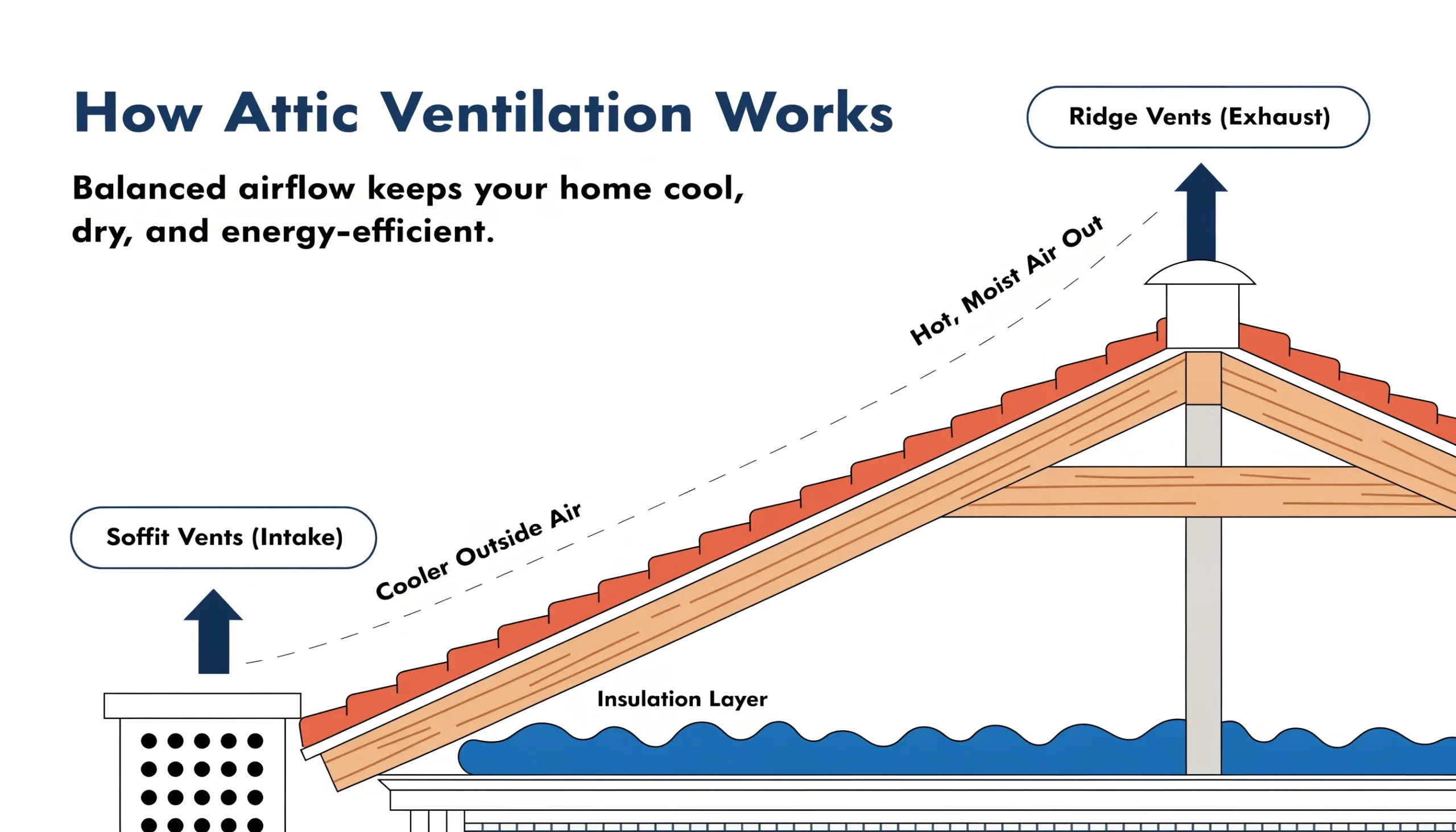
Attic ventilation only works when intake and exhaust are working together. Soffit vents, tucked under the roof’s eaves, pull cooler outside air into the attic. Ridge vents, running along the peak of the roof, let hot, moist air escape out the top. One without the other doesn’t do much good — a ridge vent with no soffit intake just pulls air from wherever it can find a gap (often straight out of the living space through can lights and attic hatches), and open soffits with no ridge exhaust just let heat pool at the top of the attic with nowhere to go.
The rule of thumb we use in the field is a roughly even split between intake and exhaust, sized to the attic’s square footage. Undersized or blocked soffit vents are the most common issue we run into in Manatee County attics — insulation, especially older blown-in material that’s shifted or settled, tends to drift down and bury the vents completely. That single problem can quietly cancel out an otherwise well-built ridge vent system, so it’s worth checking soffits any time an attic is being reinsulated.
A few things that throw the balance off:
- Blocked soffits. Loose-fill insulation sliding down at the eaves is the number one culprit we see.
- Too much exhaust, not enough intake. Adding ridge vents or attic fans without matching soffit intake can actually depressurize the attic and pull conditioned air up from the house below.
- Mixed vent types fighting each other. Combining a ridge vent with gable vents or a powered attic fan on the same attic can short-circuit the airflow path instead of helping it.
Getting this balance right is usually a one-time fix, and it pays off every single month afterward in lower cooling costs.
Here’s how the two core vent types split the work, plus the extra vent types that can throw off the balance if they’re not sized or matched correctly:
Can Attic Ventilation Prevent Ice Dams and Moisture Damage?
Ice dams aren’t the first thing most Florida homeowners think about, but they’re worth understanding if you own a home with a steeper roofline or you’re comparing notes with family up north — and the same airflow principles apply to a more common local problem: trapped moisture. Ice dams form when heat escaping from the living space warms the underside of the roof deck unevenly, melting snow that then refreezes at the colder eaves. A well-ventilated attic stays close to outdoor temperature all the way across, so the roof stays uniformly cold and there’s no warm spot to trigger the melt-refreeze cycle in the first place.
In Manatee County, the more relevant version of this problem is moisture, not ice. Humid air that gets trapped in a poorly ventilated attic condenses on the underside of the roof deck and on cooler surfaces overnight, and that moisture doesn’t just evaporate on its own. Over time it:
- Encourages mold and mildew growth on roof sheathing and framing.
- Rusts fasteners, ductwork, and other metal components in the attic.
- Degrades insulation’s ability to hold its rated R-value, especially in blown-in and batt materials.
- Contributes to musty odors that drift down into living spaces.
Balanced soffit-to-ridge airflow solves both problems with the same fix: it keeps the attic closer to outdoor temperature and constantly flushes out moisture-laden air before it has a chance to condense. That’s one more reason ventilation and insulation work best as a pair rather than as separate projects — fixing one without the other only gets a home partway to where it needs to be.
FAQ
Why does attic ventilation matter for energy efficiency?
Attic ventilation moves hot, moisture-laden air out of the attic through soffit intake and ridge exhaust, so it never has the chance to sit and drag down your insulation’s performance. Keep that airflow balanced and your insulation keeps its R-value, your AC doesn’t have to work as hard, and your energy bills settle into something more predictable.
Conclusion
Attic ventilation and insulation aren’t two separate projects competing for attention — they’re two halves of the same system. Balanced soffit intake and ridge exhaust keep hot, moist air moving instead of sitting still, which protects the insulation underneath it, eases the load on the AC, and keeps humidity from turning into mold, rust, or a slowly sagging R-value. Whether the immediate concern is a high summer power bill, a musty attic smell, or just planning ahead before the next insulation upgrade, airflow deserves the same attention as the insulation itself. Get the balance right once, and the payoff shows up in every utility bill that follows.
